Reaching a Milestone

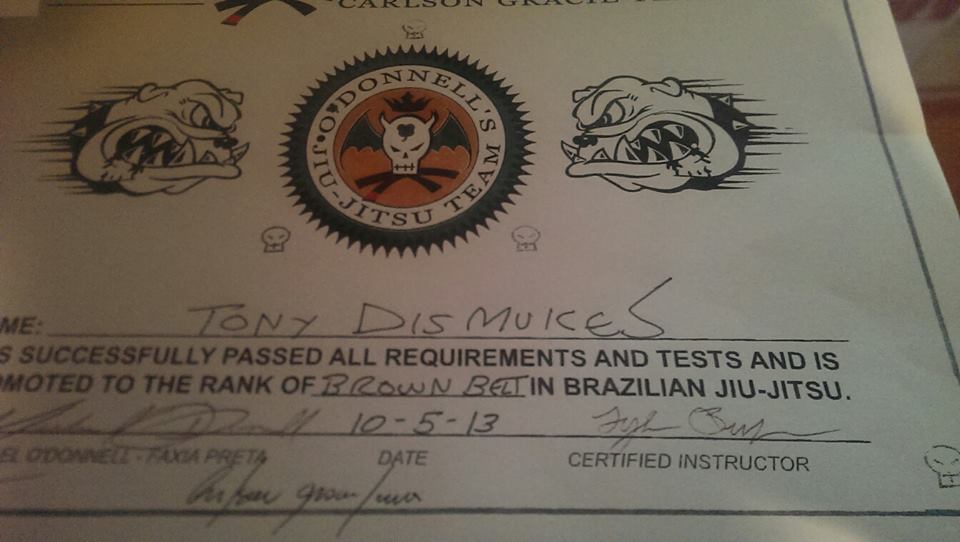
I reached a major milestone in my training yesterday – being promoted to brown belt in BJJ.

I’ve been practicing the martial arts in various forms for over 30 years. I hold black belt
ranking in a couple of arts and lower ranks in a few more. I think I can honestly say that
my journey to brown belt in BJJ involved as much time, sweat, pain, effort, and overall
learning as all my training in other arts combined.

It feels a little odd. I appreciate the acknowledgment of the work I have put into the art.
I’m confident that I deserved it. Still, a part of me thinks “a BJJ brown belt should be a
real badass on the mat. I’m competent, but I’m not really a badass.” Partly that’s because
I train with a lot of tough people. Partly it’s because I’ve learned enough to begin to see
how much more I have ahead of me still to learn. Partly it’s because I’m 49 years old with
a desk job. I’m not particularly strong or fast or athletic. My style on the mat is to
protect myself and frustrate my opponent until he gets tired or sloppy and leaves me an
opening. This sort of approach requires patience and letting go of the ego-driven thought
that I should just be able to impose my will on my opponent.

Still, it’s nice to have some validation of the fact that I’m making progress. Jiu-jitsu is
a lifetime’s study. As we learn, our standards and goalposts move along with our skills.
Sometimes they move even faster, making it hard to realize that we’re actually improving at all. Every so often it’s good to get feedback saying “yeah, you’re really getting
somewhere.”


Image

Posted in Uncategorized | Tagged , | 3 Comments

BJJ and Chess

Brazilian Jiu-Jitsu is often compared to a physical game of chess. This is an apt metaphor,
but BJJ players who don’t also play chess may not realize the specifics of the
similiarities.

Position: If you watch two knowledgeable chess players in a match, you may wait some time before you see a single piece get taken. The early stages of the game are typically spent fighting for positional dominance. If one player can arrange his pieces so that they
support each other and have space to move while isolating his opponent’s pieces and limiting their room to maneuver, then that player is on the road to victory. This concept should be familiar to all BJJ players. “Position before submission” is a widely recited BJJ mantra. Much as on a chess board, a jiu-jitsu player will try to limit an opponent’s movements and isolate his limbs before going for the finish.

Double attacks: Unless you are up against a completely clueless chess beginner, you can’t just march up to your opponent’s pieces and start capturing them. In chess, your opponent gets to move each time you move. If you move your rook into position to capture his knight, then he can move that knight to a safe position or move another piece to capture your rook in return. In order to win material, you have to learn how to make a single move that produces multiple threats. Perhaps you can use a fork: move your rook so that it threatens both the knight and a pawn. When the opponent moves to protect his knight, you can capture the pawn. Another possibility is a discovered attack. Maybe when you move your rook to threaten the knight, it exposes a clear path for your bishop which was behind the rook to threaten the opponent’s queen. Then when he moves his queen to safety, the knight is left unprotected. Once again, this should be familiar to BJJ players. Against a skilled opponent you will rarely be able to just seize an armbar, for example. As soon as you move into position to threaten the armbar a smart jiu-jitsuka will defend the arm. Instead, you must make a single move that produces multiple threats. Perhaps you maneuver into a position where if your opponent defends the armbar you can choke him, but if he defends the choke you can armbar him, and if he defends both you can sweep him.

As a side note, this illustrates an important concept for any martial art: the idea that
when you get a move your opponent also gets a move. Too many martial artists are fond of
demonstrations where an attacker makes a single attack and then stands around like an idiot with his punching arm extended while the demonstrator goes through a 15-move combination. Unless you are literally 15 times faster than your attacker, it isn’t going to happen that way.

This concept leads us to another core component of both good chess and good jiu-jitsu:

Efficiency: In chess, if you make moves which don’t advance your position or build credible threats on your opponent then you will very likely find yourself unprepared as his unified army crushes your own on the way to checkmating your king. In jiu-jitsu, if you make moves which don’t advance your position or make credible threats on your opponent, you will end up just tiring yourself out to no avail and getting crushed by a more skilled adversary.

If you enjoy technical BJJ and have never played chess, it might be worth giving it a try.
Pick up a copy of Yasser Seirawan’s Winning Chess Tactics, find an opponent, and have some fun. You might get some insights into your martial art from another angle.

Posted in Uncategorized | Tagged , , , | Leave a comment

Using Strength

Back in my days training Bujinkan Taijutsu we were taught never to use physical strength.
Pure technique, we were told, could overcome any disadvantage in size or strength. Using
strength would not make our techniques any more effective and would slow our progress in learning the art. Since technique in the Bujinkan is normally practiced exclusively with
compliant partners who are taught to attack and react in a specified manner, this generally worked just fine.

The ideal of relying on technique rather than size or strength exists in judo and jiu-jitsu
as well. Jigaro Kano wrote about using an opponent’s power against him when executing a throw. Helio Gracie actively promoted BJJ as an art where a small person could use skill
and technique to defeat a larger, stronger opponent. Nevertheless, all high-level judo and
BJJ competitors train to be as strong as possible. When students in either of those arts
starts serious randori practice, they soon discover that strength can indeed make a
difference.

To understand this apparent dichotomy between ideal and reality, you have to understand the function of technique in overcoming strength. Technique is not magic, it works on principles of physical mechanics and leverage. If my opponent is 2x stronger than I am, but I can maneuver him into a position where I have a 4x advantage in leverage, then I am effectively twice as strong as he is and I am winning. Typically at the very end of a submission, you should be in a position relative to your opponent giving you a huge leverage advantage sufficient to overwhelm even a much stronger foe. At the moment of executing a throw you should be in a position to apply force at an angle your opponent doesn’t have the balance or body alignment to resist. At the moment of landing a punch your body should be aligned to put your full body weight behind the punch while being at an angle relative to your opponent which makes it hard for him to hit you back effectively.

The tricky part in all this is getting your opponent into the position and alignment which
allows you to have this wonderful mechanical advantage. You can’t just grab him and
physically force him into the bad position, unless you are much stronger than he is. The
commonly accepted solution to the problem in arts such as jujutsu, aikido, taijutsu, and
many others, is to avoid fighting your opponents force with your own. Instead,
practitioners of these arts attempt to blend with an attackers energy and redirect it so
that the attacker ends up in a disadvantaged position. (Surprise and distraction tactics can also be use to help this process along.)

This concept appears to work beautifully when demonstrated on a training partner who gives you a telegraphed, over-committed attack and then makes no effort to compensate as you redirect his force so that he is off-balance and out of alignment. It gets much messier in the real world. A competent opponent who feels himself bringing brought off-balance will adjust his feet to regain that balance. If he feels his limbs being guided out of good alignment, he will pull them back to an anatomically strong position. If he sees you gaining a superior angle, he will move to follow you. He will do this quickly and he will
do it while simultaneously attempting to break your own balance, force you into a bad angle, or just smash your face in the middle of the process.

To complicate things further, if your opponent is stronger than you and not a technical
martial artist he will have no qualms about matching his strength directly against yours to
force you into the position where you are the one who is off-balance, out of alignment, and at a bad angle. If the attacker knows what he is doing with this sort of attack then it
will not be so easy to just blend with and redirect as the stylized and over-committed
attacks you commonly see in taijutsu and aikido dojos. If you haven’t already achieved a
superior angle and position by the time your opponent gets hold of you, then you may be in trouble.

All that being said, technique can overcome size and strength – it’s just more challenging
than cooperative demos would normally lead you to believe. You have to continually adjust to your opponent’s movements more quickly and fluidly than he can adjust to yours. The stronger he is compared to yourself, then less margin for error you have. If your opponent has the same degree of strength that you have, then you can safely engage at a position of equal leverage and attempt to technically maneuver into a superior position. If your opponent is twice as strong as you are, then you can never allow him to engage you at a position of equal leverage because then he could use his superior strength to force you into a position of inferior leverage and then you’re really in trouble. If you want to keep an opponent from ever even reaching a position of equal leverage with you, then you better be a lot more skilled than he is. In my experience, the best and possibly the only way to reach that sort of skill is many, many hours of sparring/free-grappling/live drills with resisting opponents.

There is a trade-off then, between the needs for strength and skill. The more you are
outmatched in strength the more skill you need to compensate (and vice-versa). The
philosophy of jiu-jitsu is based on using technique to beat strength, but that isn’t the end
of the story. In jiu-jitsu competition you are matched up with opponents who have similar
levels of technical expertise and so strength and athleticism come into play. If I have only
a 5% skill advantage over my opponent and he has a 50% advantage in strength, then he is probably going to walk away with the victory. This isn’t strictly limited to sportive
competition. If I am attacked on the sidewalk my assailant will probably not be trained in
jiu-jitsu, but he may very well have practical fighting skills developed in dozens of real
street fights. For me to assume that a street attackers strength relative to mine is
irrelevant just because I am skilled in BJJ would be foolishness.

The precepts instilled during my Bujinkan training time have been useful to me as I have
studied BJJ. I never try to overwhelm an opponents strength with my own in order to force a technique. Nevertheless there are places where strength is useful. Firstly, to keep from
being overwhelmed and forced into a bad place by a stronger opponent who I have not yet found a way to outmaneuver using technique. Secondly, to move my body weight (and sometimes my opponents body weight) against gravity. Thirdly, to protect against injury. Our bodies go through a lot of abuse in BJJ, so a strong core and strong neck muscles can be reduce the chances of getting hurt.

Right now my personal challenge is finding the time and energy to do any sort of regular
strength training when I already push my body’s recovery limits by training jiu-jitsu 5 days per week. I’m still figuring out the best approach for that.



Posted in Uncategorized | Tagged , | 1 Comment

Greater than the sum of the parts

If you’ve had the opportunity to train with a variety of BJJ instructors, you’ve probably noticed that they teach the same techniques a little differently than each other. One teacher might introduce technique A, while another might start you off with a variation A1, and another might insist on variation A2. One instructor might teach technique B1 as the basic and later introduce B5 as an advanced variation, while another might do the reverse.

One reason for this is that techniques don’t stand on their own in a vacuum. You can’t really say “this is the most effective way to perform an armbar, this is the most effective way to kick, this is the most effective way to escape the mount, etc so I’m going to just practice those techniques and I’m going to be unbeatable.” A technique in isolation is only half the story at best. More important is how the technique fits with other techniques and works into your larger strategy – what is referred to in BJJ circles as your “game.”

Once you realize this, you start understanding why different instructors will emphasize different variations of the same technique. One instructor might be a small guy with a fast-paced attacking game and will use technical variations which allow for maximum mobility and grabbing submissions in the midst of a scramble. Another might be a methodical figher who prefers technical variations for taking away his opponents space and patiently crushing the wind out of him.

The game that works well for one individual may or not work well for another. We all have different body types, different personalities, and different priorities. The best game for a skinny, flexible, cautious individual focusing on self-defense will probably not be the same as the best game for an strong, inflexible, aggressive heavyweight focused on gi competition.

Some coaches will teach their preferred game as a one-size-fits-all approach. Other coaches will teach individual techniques and leave it up to the individual student to develop his or her game in the crucible of free-grappling and sparring. This will usually work out eventually, but if you are having trouble with the process it can be useful to take a step back and ask yourself some questions to consciously eveluate your game.

What is your ultimate end goal? What is your over-arching strategy to reach that end goal? What is your first go-to technique to begin executing that strategy? What is your flowchart for moving to follow-up techniques when your first technique gets countered? Are there sections of that flowchart which are unclear? Do the techniques you favor work well together so that one flows into the next? Do they support your overall strategy and move you closer to your end goal? Why are you choosing this technical variation instead of that variation? Are there certain areas where your game is better developed than others?

I’ve just started applying these questions to myself and the results are illuminating. My guard game is reasonably good, and one reason is that I have a clear strategy and I know how to execute it. First I protect myself from strikes and I work on breaking my opponent’s posture. Then I start working my angles. If my opponent exposes a limb then I take the submission, otherwise I continually attack his base to set up a sweep or take the back. If he backs off then I get to my feet. I have lots of little “what-ifs” worked out for different reactions my opponent might give me.

In contrast, my takedown game is quite weak. I know plenty of throws and takedowns and can demonstrate them adequately in isolation, but my actual performance in randori is mediocre at best. For a long time I attributed this to inadequate strength or speed or conditioning or practice with the individual throws. Recently, through, I’ve realized the biggest problem is lack of a game plan. When I go out to practice stand-up randori I don’t have a clear idea of what my first move is going to be or what my immediate follow-up will be when my first attempt gets stuffed. One of my goals for the rest of this year is to try figuring out at least a rudimentary game plan which will allow me to make good use of the takedowns I already know.

I haven’t yet figured out the best way as a coach to help someone figure out their own game. One thing I am trying to do is at least explain techniques in context so that students can see how they fit into the big picture. If anyone has suggestions that have worked well for them in coaching, please leave them in the comments.


Posted in Uncategorized | Tagged , | Leave a comment

Surviving the Marathon

On the one hand, I’m 49 years old with a desk job and several nagging old injuries. Things don’t heal as fast as they used to, and I was never any kind of remarkable physical specimen to begin with.

On the other hand, I’m training Brazilian Jiu-Jitsu 5 days per week.

These two hands don’t always play together nicely. BJJ can be less than kind to the body. It’s not a good situation when I need to get some sleep but I’m aching too badly to get comfortable. As a result, I’m trying to be more disciplined about taking care of myself so that I can still be having fun on the mat 30 years from now. As Helio Gracie showed us, Jiu-Jitsu is a marathon, not a sprint.

Here’s some of what I’ve found to be helpful:

Yoga is excellent not only for maintaining the flexibility to avoid injury, but also for working out the deep muscle knots that develop after a hard jiu-jotsu workout.

Keeping it playful. Ryron Gracie has been spreading this message and I believe it’s vital for those of us who are creeping up in years. When I fight like crazy for every point on the mat in your regular rolling, then my body just takes too much abuse. When I stay relaxed, go with the flow, and see what happens from every position without too much concern for who is winning, then I walk away with a lot less soreness.

Train core strength and suppleness. A strong midsection does a lot to protect the back.

Don’t rely too much on flexibility. I’m flexible enough to pretzle-ify my body a fair bit while fighting off a guard pass. Sometimes it’s better for long-term back health to just give up the pass, maintain a more anatomically correct body position, and work on escaping the side mount.

Look ahead to danger spots. Related to the point above, if I can maintain awareness of positions which are likely to be bad for me (getting tangled in a knot, having someone grab my head, being excessively twisted, etc), then I can try to avoid the movements which are going to get me hurt.

Ice. I’ve been having some success treating a chronic wrist injury with contrast therapy (alternating ice water with hot water). My newest experiment is replacing my traditional post-workout hot bath (intended to relax my muscles) with a post-workout ice-water bath (intended to reduce joint inflammation).

Rest. Getting adequate sleep is vital to recovery. Knowing my body well enough so that I can tell when I need to back off and skip a workout is important as well.

If anyone else has suggestions for maintaining long-term health while training hard, please leave them in the comments.

Posted in Uncategorized | Tagged | Leave a comment

Pattern Recognition

When playing chess, I spend a lot of time trying to predict my opponents possible moves. I
assume he is going to make the best possible move, so if I move A, then he’s going to move B, if I move C then he will move D. Even if I am in a bad spot, I can hopefully select the least bad course of action.

Recently, it’s occurred to me that this can be a useful approach in grappling, particularly
when I am rolling with certain individuals who are skillful enough to completely dominate me on the mat. With these individuals, my chances of actually winning are pretty much
non-existent. I have been working on just trying to survive, but that can still get frustrating as they crush my defenses.

What I’m trying now is to just predict what they are going to do next based on what I do.
If I go left he’s going to sweep me. If I go right, he’s going for the choke. If I block the choke, he’s going to my back. I may or may not be able to stop any of those techniques,
but if I can predict what happens next, then I am learning and getting one step closer to
being able to survive.

As I do this, I find that everyone has their own patterns of attack. In some cases I can
survive longer against a black belt that I am accustomed to working with than a brown belt I’m not so used to.

I think I just decided on a training goal for the next couple of weeks. Whenever I roll
with anyone, beginner or advanced, I want to spend more mental energy on discovering whether I can predict his next move than whether I can avoid tapping.  Let’s see how this works out.

Posted in Uncategorized | Tagged | Leave a comment

Review: Gracie University Online

A few years ago, Ryron and Rener Gracie created GracieUniversity.com. The idea is that
students can set up a trining space in their garage, find a training partner, and progress
through the ranks of Gracie Jiu-Jitsu training exclusively through Rener and Ryron’s online instructional videos and testing for belt ranks via video as well.

I’m have some pretty serious reservations about the concept of training without a live
teacher, but I’ve been using the videos for almost a year now as a supplement for my
training at my regular gym and I’m offering up this review for anyone who’s curious about
the quality of the video instruction.

Price: Varies by tier. $35/month gets you a gold membership which includes all the video
lessons (but not some of the bonus extras). If you plan to test for rank, they charge a fee
for each rank test.

Content: I believe their ultimate goal is to have instructional videos covering all the way
up to black belt, but right now all they have is material up to blue belt, 2nd stripe.
That’s still quite a bit of material. As of today (July 2013) they have 36 lessons (averaging about 1/2 hour each) for white belts and 91 lessons (averaging about 1 hour each) for blue belts. They also have additional material for women’s self-defense. They seem to be adding a new batch of lessons about every 4 – 6 months.

Quality: Remarkable. I’ve been a collector of martial arts instructional videos for years
and I have to say that Rener & Ryron’s videos are better than anything I have ever seem
before by an order of magnitude. Each lesson (1/2 hour to an hour) typically covers just one technique (with some variations) or a short sequence of related techniques. In the lesson, they cover the fine details of the technique, when to use it in a fight, the principles that make it work, how it fits in combination with other techniques the student may have learned, common mistakes to avoid, what to do when something goes wrong, safety precautions for practice, training drills, how to coach your partner and practice most effectively with your partner so that both of you progress as rapidly as possible. The wealth of information may be a bit much for those students who tend towards impatience, but for detail-oriented folks like myself it’s great.

Besides the quality of the individual lessons, I appreciate the fact that the material fits
together into a cohesive curriculum. The techniques and principles from one lesson feed
right into the next lesson and the practice drills presented typically make use of material
from previous lessons.

The 36 introductory lessons covered techniques that I was familiar with, but they reminded me of details that I had forgotten or that I was doing unconsciously. They also gave me useful drills for burning in pattern recognition and reflexes that my students have responded well to.

The blue-belt level lessons include plenty of techniques and details that I did not know.
I’ve been applying that information for my own development and I’ve been seeing the
improvement on the mat.

Who this is for: If you are looking for the newest and most esoteric competition techniques to surprise your opponents at the tournament, then this is not for you. The material they have up at this point is aimed at building a super solid grasp of jiu-jitsu from the foundation up. If you want to polish your fundamentals, then I believe these videos provide useful information for white belts, blue belts, purple belts, and even brown belts.

These lessons are also probably not for anyone suffering from ADD. I know some students who can only follow a few minutes worth of instruction before their minds begin to wander and they need to start practicing and figuring out for themselves. If you are one of those students, then a 45-minute lesson explaining every last nuance of how and when and why to perform a given technique will probably be too much. If you love details, on the other hand, then these lessons are for you.

Final thoughts: I’m still somewhat skeptical of Rener & Ryron’s aim of producing high-level
students purely through online lessons. The instruction is absolutely top-notch, but part
of the learning process in BJJ is time spent on the mat rolling with a wide variety of
training partners. Over the years I’ve rolled with hundreds of training partners, with
completely different body types, training backgrounds, personalities, and movement styles. I’m not sure you can replace that with time spent training with a buddy in your garage no matter how good the video lessons are. On the other hand, if you are just looking for a training supplement, then these lessons are excellent.

You can find more details at www.gracieuniversity.com

Posted in Uncategorized | Tagged , | 2 Comments

Teaching or Natural Selection?

Over the years I’ve visited a lot of BJJ schools. One of the most common methods of structuring a class seems to go like this:

Warm-ups
Demonstrate and drill one or two random techniques
Free-rolling/grappling for the rest of the class period. This will take up at least half the class time and frequently much more. Sometimes the instruction is skipped entirely in favor of just rolling.

One defense of this approach is that it seems to work. Lots of the schools that practice this way are filled with tough, skilled jiu-jitsu practitioners. What more could you ask?

This type of class definitely does have its time and place. However, I would argue that it is far from ideal for the people who need jiu-jitsu the most.

What happens when a new BJJ student arrives to his or her first class if it is taught in the manner described above? They learn a couple of techniques devoid of context and then they are tossed into the shark tank for the more experienced grapplers to play with. Hopefully it’s a friendly school and the sharks won’t fold, spindle and mutilate them too badly. Even so, if the new student doesn’t have any prior grappling background he or she will likely be lost and confused and will end up very sore the next day.

After an introduction like that, who is likely to come back for another class and stick around long term for training? The folks who are athletically gifted. The ones who are mentally tough as nails. The ones who are absolutely determined. The ones who have previous background of some sort that prepared them for the experience. In other words, the school is engaging in Darwinian selection to keep the people who would naturally excel in any martial art or fighting sport and weed out the people who need self-defense training the most.

This approach is totally valid if your goal is just to build a winning competition team. In that case it makes sense to start out with the most talented and determined athletes. To my mind, however, BJJ is a martial art which enables the weak to protect themselves from the strong and a lifestyle that can be practiced for health at any age. From this standpoint, the mark of a great teacher is not necessarily a top competition team. Instead, a great teacher would be the person who can take a small, unconfident, non-athletic beginner and encourage them and guide them through the process of self-transformation which will allow them to step on the mat with the sharks and not be intimidated.

When I teach beginners, I try to give them a technical foundation which covers the most common positions presented in a meaningful context, and then take them through an incrementally progressive series of exercises, from static repetitions to pattern recognition drills to positional drills to focus sparring to full out free rolling. In future posts I will address some of these methods in more detail.

Posted in Uncategorized | Tagged , | Leave a comment